
FAQs

Frequently asked questions

Why is live tumor profiling important?

Live tumor profiling enables the measurement of changes in living tumor tissue following treatment. Unlike methods that rely on fixed tissue from a single time point, live tumor profiling provides a more accurate model of immunotherapy response because it preserves tumor and immune cell interactions and captures the dynamic changes that occur in real time following treatment. Live tumor profiling offers the potential to predict how a patient will respond to immunotherapy by mirroring how cancer cells may respond within the body.
Why are cytokines important in IO response prediction?

Cytokines are essential molecules involved in a variety of cellular processes including immune regulation, inflammation, wound healing, hematopoiesis, and cell differentiation. Most notably for oncology, cytokines activate and suppress immune cells that can attack cancer. By understanding the types of cytokines secreted after administration of an IO agent and the rate at which they are produced, researchers and physicians can better predict if a particular therapy activates cytotoxic T-cells for inhibiting cancer growth.

What are live tumor fragments? How do you keep them “alive” in culture?

Live tumor fragments are small pieces of tumor tissue, about the thickness of three human hairs, generated from tumor biopsies. Biopsies are cut into live tumor fragments and encapsulated in a hydrogel that supports cell health. The hydrogel creates a matrix around the live tumor fragments that mimics the physical structure of the tumor in vivo and helps to maintain the tumor microenvironment. Culture medium containing critical growth factors and nutrients is added to the live tumor fragments to keep cell populations viable for study ex vivo for up to 72 hours. 

What is ex vivo functional profiling?

Experiments focused on the biological activity of specimen acquired from and kept alive outside the body. In this approach, the aim is to assess the responsiveness of cells to a particular drug or small molecule. Elephas scientists then observe the cells' responsiveness through cytokine profiling for T-cell activation. Ex vivo functional profiling for immunotherapy response allows physicians and researchers to better predict how a tumor is likely to respond to a drug. 

What is tumor heterogeneity and how does it impact response to IO?

The term tumor heterogeneity means that not all cell types within a tumor are the same. A tumor is made up of a mixture of cells types with different characteristics, which leads to distinct subpopulations of cells that may grow at different rates or interact differently with the immune system. The tumor may also contain areas where the tissue is dead or necrotic.

Some tumor regions may be highly responsive to immunotherapy, while other tumor regions may evade immune attack or suppress the immune system. Depending on which part of the tumor is studied ex vivo, a different response to IO may be observed. As a result, it’s important to take measures to mitigate the challenge of tumor heterogeneity in ex vivo studies. Some studies use large amounts of tumor tissue from resections, cutting the tissue up into small pieces and mixing them together to minimize the effects of tumor heterogeneity. The Elephas platform takes a different approach that enables the measurement of response to IO in small amounts of tumor tissue from core needle biopsies. 

Why is preservation of the tumor microenvironment important for measuring IO response ex vivo?

The tumor microenvironment (TME) is a complex mixture of immune cells, stromal cells, tumor cells, and extracellular matrix proteins. Cells present in the TME secrete small proteins, called cytokines and chemokines, that act as signals to the surrounding immune cells and can either promote or inhibit tumor growth. Many factors including cell types and cytokines present in the tumor microenvironment influence whether it is immunosuppressive (sometimes called “cold”) or inflamed (sometimes called “hot”). Whether the TME is cold or hot drives response to immunotherapy. Maintenance of the native TME in ex vivo profiling of tumor tissue therefore offers the greatest potential to accurately predict the likelihood of response to immunotherapy, and understanding the TME will help researchers design more effective immunotherapies. 

What is a sequential treatment strategy and how is it used to assess cytokine response?

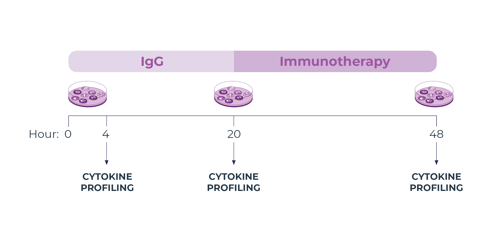
Method-treatment-timeline-white backgroundA sequential treatment strategy is an approach that is used to mitigate the challenge of tumor heterogeneity in small amounts of tissue, such as from core needle biopsies, when measuring cytokine response to IO ex vivo. The tumor tissue fragments are treated first with IgG control, called the control phase, followed by immune checkpoint inhibitor, called the treatment phase. 

This approach is different from the typical cross-well comparison experimental design, in which one replicate of tumor tissue is treated with a control and another replicate is treated with a drug, and the cytokine measurements from each replicate are compared. 

In the sequential treatment strategy, cytokine measurements from the control and treatment phase are taken from the same sample of tissue. This approach mitigates the challenge of tumor heterogeneity because tissue samples are compared to themselves at baseline, not another sample that may contain a different makeup of cells responding differently to treatment.

How does the Elephas Live Platform compare with existing predictive biomarkers?

Existing predictive biomarkers have limitations when guiding treatment decisions for cancer patients. Currently, only 1 in 5 patients respond to immune checkpoint inhibitor treatments.

The Elephas Live™ Platform is an ex vivo platform that measures cytokine response in live tumor biopsies following treatment with immunotherapy. The platform provides functional insights that can be used for immunotherapy response prediction.

What sample is required?

The platform requires a fresh core needle biopsy, which can be obtained during a standard-of-care diagnostic procedure. Biopsies must be collected using 12- to 20-gauge probe, and be 10 mm or more in length. 

What data or evidence do you have supporting the use of platform?

Elephas has 3 ongoing clinical trials across 15 sites evaluating the concordance of response measured on the platform with patients’ clinical response. To date, we have measured cytokine responses to immune check point inhibitors (ICIs) from 167 patient biopsy specimens and 27% of specimens show a cytokine response to ICI on the platform. In our independent validation cohort of 20 patients with corresponding clinical data, the Elephas Live Platform correctly identified 8 of 9 patients (89%) who had an objective response to ICI (partial response or complete response), including 5 patients who were negative for standard-of-care ICI biomarkers. Further, all 5 of 5 patients (100%) with clinical progressive disease were identified as non-responders on the platform.

What cancer types are you measuring IO response to?

Elephas will evaluate any solid tumor that is eligible for immunotherapy. This includes head & neck, kidney, breast, liver, lung, and a variety of skin cancers that include melanoma or squamous cell carcinoma. We attempt to identify which treatment the tumor receives based on the cancer presented, then we apply the same treatment to our ex vivo model. In the absence of provider-guided therapy options, drugs are applied based on NCCN guidelines and drug labels.

What are the major steps involved in the Elephas Live Platform?

Elephas Live Edge – cutting instrument that precisely cuts biopsies in under 10 minutes in 300-micron sections at a 20-degree angle.

Elephas Live Protect – proprietary hydrogel formulation that we use to encapsulate live tumor fragments to preserve the tumor microenvironment.

Elephas Live Method – Sequential treatment and supernatant collection for cytokine profiling. Encapsulated fragments are kept alive over the course of 72 hours. Supernatants are collected at four time-points for downstream cytokine analysis: CT1 – 4 hours, CT2 – 24 hours, TX1 – 48 hours, ST1 – 72 hours.

Our mission is to develop an innovative platform that enables prediction of clinical treatment outcomes for cancer patients and accelerates drug development.

We are

  • Passionate about improving the lives of cancer patients
  • Enthusiastic teachers
  • Grounded and gritty
Pooja Advani
Pooja Advani,
MBBD, MD

Medical Oncologist
Breast Cancer
Mayo Clinic

David Braun
David Braun,
MD, PhD

Medical Oncologist
Kidney Cancer
Yale School of Medicine

Christian Capitini
Christian Capitini, MD
Director
UW Health | Carbone Cancer Center

Kevin Eliceiri
Kevin Eliceiri, PhD
Professor of Microscopy, Medical Imaging & AI
The University of Wisconsin-Madison

Janis_Marie_Taube
Janis Marie Taube,
MD, MSc

Pathologist
Melanoma
Johns Hopkins Medicine